
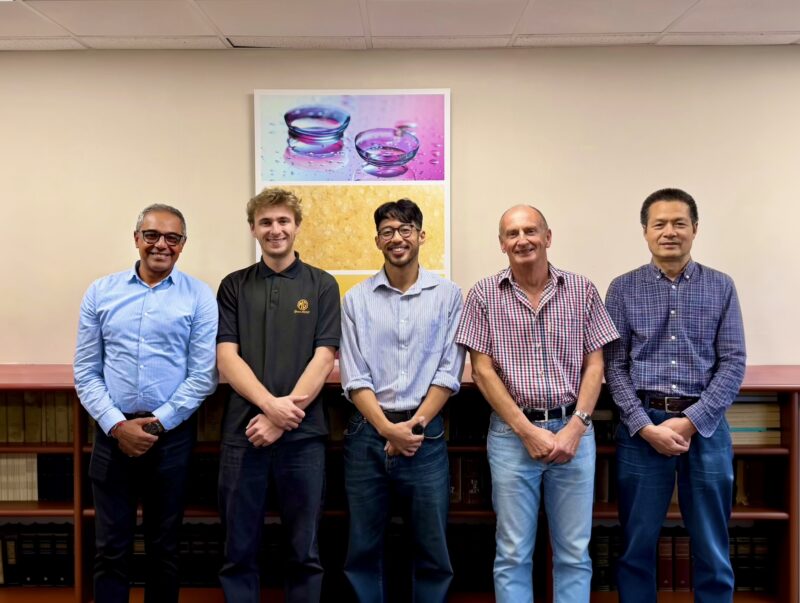
Pictured from left to right are: Chandres Surti, Sean Gage, Aldrich Miguel, Michael Parker, and Yingfa Li.
Behind every contact lens, intraocular lens and dental adhesive is a carefully engineered material. Cornelius Specialties supplies monomers and macromers to the ocular and dental markets. These are the materials used in silicone hydrogel and rigid gas permeable contact lenses, intraocular lenses, and dental adhesives and cements. The chemistry behind them is methacrylate and functionalised organosilicone chemistry, and the materials have to deliver properties such as optical clarity, gas permeability and durability.
Each of those materials starts as an idea on paper. By the time it reaches a customer, it has been trialled in the lab, scaled up in the pilot plant, then tested, measured and released. At Cornelius Specialties, the R&D and Analytical Services team has a hand in every step.
Meet the six people behind that journey: a chemist whose career has taken in aerospace adhesives and sensor holograms, a lab technician with journal publications in polymer chemistry, and colleagues whose paths began with a love of chemistry at school, an industrial placement or an apprenticeship. We asked them about their roles, what they’re proud of and what’s coming next.
New to the terminology? There’s a quick guide to the chemistry and lab terms at the end of this post.
Meet the team
Since September 2026, R&D and Analytical Services have come together as one team under Chandres Surti. This brings the two disciplines under a single technical leadership structure, pooling the team’s resources and capabilities, supporting innovation, product quality, customer requirements and future growth. Today the team covers everything from first lab trial and pilot plant scale-up to testing production samples.
Chandres Surti (CS), Head of R&D and Analytical Services
Chandres leads the combined team, bringing technical expertise, leadership and a clear vision for its technical capability. He has quickly become a key member of the site’s leadership team and has helped drive improvements across several technical areas. Earlier in his career, he led a team developing totally novel compounds for the wider pharmaceutical research community, and he still loves nothing more than time in the lab.
“My role is multi-faceted. It can range from being very hands-on in the lab or in production to project management, managing resources and strategy meetings. I really enjoy this mix, as it lets me spend time in the lab doing what I love most while also sharing my knowledge and experience with other team members. I see it as an opportunity to upskill, mentor and coach my team on their professional and learning journey.”
Sean Gage (SG), Analytical Services Lead
Sean’s route into science ran through apprenticeships and a range of roles within the company. Now he leads Analytical Services and is the business’s analytical contact for outside parties.
“My role is to look after the Analytical Services team in the testing of both in-house manufacturing and research projects. My usual day-to-day involves managing the workload of the team through planning and strategic meetings, providing hands-on support if needed depending on the number of planned samples. I also organise the servicing of our equipment in the lab and liaise with external parties as the analytical contact for the business.”
Michael Parker (MP), Analytical Chemist
Michael has worked as a chemist in the manufacturing industry for over 50 years, from photographic products to fire-resistant paints, before joining Cornelius, where he keeps the key equipment running.
“My role is to maintain liquid chromatography equipment (HPLC and GPC) and to log data from this equipment (plus GCs). By doing this, analytical performance can be monitored, enabling failures to be predicted and reducing equipment downtime. I also provide support for general QC testing of production products at intermediate and final stages. A typical working day can involve any of the above activities, plus liaison with a service engineer if any equipment problems cannot be dealt with by myself or colleagues.”
Yingfa Li (YL), Synthesis Chemist
Yingfa takes ideas from paper to production line, writing the first SOP before a project moves on to larger scales for the operators.
“My role is to try to realise the dreams of Cornelius managers and directors, taking ideas from paper to production lines. Using available knowledge from a wide range of areas, as well as my own knowledge and skills, I start them on small lab scales. My work involves obtaining direction and help from our leaders, then looking at possible approaches and routes, and examining, modifying and creating routes through trials, analysing the experimental results with the QC team. When a viable and practical route has been created, I create an SOP version 1, and the project then moves on to larger scales for the operators, with my help. When the project has moved smoothly into the product stage, my role in this cycle is complete and I move on to the next project.”
Aldrich Miguel (AM), Technical Operations Chemist
Aldrich’s Cornelius story began with an industrial placement during his chemistry degree. Today he runs kilogram-scale lab reactions and helps scale them up to the pilot plant.
“My role consists mainly of conducting and optimising kilogram-scale lab reactions to make various ocular and polyamide compounds. Once optimised, I look to scale up these products to pilot plant scale in collaboration with the production, engineering and health and safety teams at Cornelius Specialties. The synthesised compounds are then evaluated by the analytical team and eventually sold to customers. I also support with method development, strategy meetings and updating risk assessments and COSHH forms.”

Burney Jose (BJ), Lab Technician
Burney’s love of chemistry goes back to school, and her journal publications focus on polymer chemistry. Day to day, she tests production samples to make sure they meet specification.
“My role is mainly focused on QC testing of production samples to make sure they meet the required quality and specification standards. A typical day involves receiving and preparing samples and carrying out analytical testing using techniques such as HPLC, GC, FTIR, UV-Vis, wet chemistry and particle size analysis, working closely with the production team to provide accurate and timely results. Alongside routine testing, I support method development, validation and technology transfer when required. I enjoy the practical nature of the role and the problem-solving involved when investigating unexpected results.”
What led us here
How do you end up developing and testing materials for a living? For some it began with a favourite subject at school, for others an industrial placement, an apprenticeship, or decades in other industries. What they share is a fascination with how materials behave.
CS: “I’ve always been keen on a career in science, and chemistry in particular, as I found it very logical. My fascination with R&D began early in my career when I was tasked with developing a new portfolio and product range, and I went on to lead the R&D team in developing totally novel compounds for the wider pharmaceutical research community. It was the thrill of developing new compounds that drove my ambitions. Working with methacrylate and organosilicone chemistry can be very challenging, as these materials behave very differently to other organic chemicals. I enjoy that there are always new problems to solve, and sharing our findings with the wider Cornelius Specialties team.”
AM: “What attracted me to R&D was an industrial placement at Cornelius during my chemistry degree. I enjoyed tackling new challenges every day and seeing my degree applied in an industrial setting. The fast-paced nature of R&D, and seeing my work progress and make a positive impact on the company, made me pursue this career path. Methacrylate and organosilicone chemistry can be difficult, but it’s that challenge that makes it enjoyable.”
SG: “I was fairly certain early on that I wanted to work in the scientific industry, and my experience through apprenticeships and various positions within the company cemented that. From an analytical perspective, I like learning the theory behind the techniques we use to confirm the quality of our products, and how that relates to their application by our customers and end users.”
MP: “I have worked as a chemist in manufacturing industry for over 50 years. I have worked on photographic products, adhesives for aerospace, fire resistant paints and sensor holograms before joining Cornelius. I enjoy using my past experience in product and process development plus analytical chemistry to improve our QC facility.”
YL: “The interesting and useful projects I have been working on have kept me with our company for a good while. My success in R&D will benefit our company for years to come. We advance our company in terms of technology and products.”
BJ: “Chemistry has always been my favourite subject, going right back to school, and I’ve always been curious about polymer chemistry, which is the focus of my journal publications. I was attracted to R&D and analytical science because it’s a fast-growing field with new materials, technologies and challenges all the time. What I enjoy most about methacrylate and organosilicone chemistry is that the work is never repetitive, and I get to apply my analytical knowledge to real production challenges and understand the chemistry behind the results.”
What we do for our customers
Put simply, customers get high-quality materials they can use with confidence. R&D develops and improves the products and secures the supply chain behind them. Analytical Services tests them before they ship, and the team keeps supporting customers afterwards, from shelf-life extensions to evaluating new products.
CS: “Within R&D we are looking at various areas of the business. One of those is process improvement: how can we make an existing manufacturing process better, with higher quality and therefore more cost effective. We are also looking at expanding our product range, looking to offer new compounds to our customer base. We are also looking at securing our supply chain by investigating the potential of alternative suppliers for some of our more critical raw materials. This is important as it will allow for business continuity and will de-risk our supply chain.”
AM: “The R&D and Analytical Services teams serve as the technical bedrock of the company that makes high-quality products that are sold to customers.”
BJ: “We help deliver high-quality products worldwide and give customers confidence in our materials. We provide ongoing technical support, respond quickly to technical and analytical issues, assist with shelf-life extensions, and work closely with customers as they assess and adopt new products. By maintaining product quality and solving customer challenges, we build strong, long-term relationships.”
How we support the wider business
The team’s work reaches well beyond the lab, from future investment planning to the decisions production makes every day.
CS: “For me it’s about using my R&D and production knowledge and experience to develop plans and strategies that move Cornelius Specialties forward, whether that’s supporting the commercial teams or providing a technical view on future investment planning.”
BJ: “Our QC and Analytical Services team is the backbone of the company, because we test and release products before they reach our customers. My work helps ensure production samples meet the required specifications and that customers receive consistent, reliable products. By providing accurate and timely results, we help production make the right decisions and avoid unnecessary delays. Even though much of our work happens behind the scenes, it has a direct impact on the products our customers receive every day.”
Recent highlights
From securing new raw material sources to building new testing capability, there is plenty going on across the team.
Work continues on investigating alternative raw material suppliers and further developing the CorMelt range.
AM: “I’ve been involved in two exciting projects. The first is testing new formulations, which helps us mitigate any shortage of supplies and develop bespoke polyamides for our customers. The second is a new project that our senior leaders have identified as a priority for the business, and I’m proud to bring my technical insight and skills to it, and I hope to eventually take ownership of the project, spearhead it through to large-scale production and meet prospective customers to showcase the breadth of Cornelius’s product portfolio.”
YL: “I’ve recently completed a kilogram-scale batch of one of our products and made another using a newly sourced raw material to assess its quality and usability for a possible new supplier. The results were great.”
MP: “It has been particularly satisfying to be involved from the start in the introduction and development of HPLC and GPC techniques which have significantly extended our QC capability.”
Small team, deep experience
Ask the team what sets them apart and the same themes come up: a shared technical language, close links with production and customers, and plenty of experience in a small group.
CS: “As a combined team we share a technical background. You could say we understand each other’s disciplines. This allows us to have very technical discussions when problem solving and weighing up potential solutions. This highly technical collaboration allows for evidence-based solutions and decision making not only for us but also from the senior leaders.”
MP: “Despite being a relatively small group, we have a lot of experience between us. We work closely together and can respond quickly to unexpected problems.”
AM: “Our technical background allows us to greatly assist other teams in production decision-making, which fosters strong collaboration. Our experience in presenting our findings also gives senior leaders and customers confidence in the quality of what we produce.”
BJ: “What sets us apart is the combination of strong technical knowledge, teamwork and a customer-focused approach. We work closely together to address analytical and technical challenges quickly, and everyone brings different knowledge and experience, so there’s a strong culture of sharing ideas and finding practical solutions. We’re also closely connected with production, quality and customers, which gives us a good understanding of the impact of our work.”
What’s next
New products, a newly expanded team, more equipment as lab space allows and stronger customer partnerships: there is plenty to look forward to.
CS: “For me it’s about innovation and being able to expand what we can offer as a team to Cornelius Group, whether that is supporting the commercial team with technical support, showcasing our capabilities at tradeshows or visiting customers and suppliers. I hope with the newly expanded team we can accelerate the onboarding of new in-house manufactured products, speed up scale-up projects with pilot plant capability and continue to deliver quality to our customers.”
MP: “I’m looking forward to building in more product testing contingency by bringing on stream more equipment as more lab space becomes available.”
AM: “I’m excited to push the boundaries of what Cornelius can do and offer customers. I look forward to continuing to provide existing customers with quality service and to build relationships with new ones as the company expands its portfolio.”
BJ: “What excites me most is the opportunity for Cornelius Specialties to keep growing through new products, new technologies and stronger customer partnerships. The methacrylate and organosilicone market is developing quickly, so there will always be new analytical challenges and opportunities to learn. I’m excited to be part of a team that can support this growth by maintaining high product quality and providing strong technical support to customers.”
From first trial to final check
Whether it is scaling up a new compound in the pilot plant, extending a product’s shelf life or tracking down an unexpected result, the R&D and Analytical Services team is where Cornelius Specialties’ technical expertise meets its customers. Their work also underpins the R&D collaboration and bespoke material development we offer.
Want to learn more about how we can support your business? Explore our Ocular & Dental offering.
Terms explained
Monomer: A small molecule that can be linked with others to form a polymer, the basis of many plastics and lens materials.
Macromer: A larger building-block molecule that can also be linked into a polymer.
Methacrylate: A family of reactive chemicals widely used to build polymers.
Organosilicone: Chemistry that combines silicon with carbon-based groups. It is used in contact lens materials where oxygen permeability matters.
HPLC: High-Performance Liquid Chromatography: separates and measures the components of a liquid sample.
GPC: Gel Permeation Chromatography: measures the size distribution of molecules in a polymer.
GC: Gas Chromatography: separates and measures the volatile components of a sample.
FTIR: Fourier-Transform Infrared Spectroscopy: identifies materials by how they absorb infrared light.
UV-Vis: Ultraviolet-visible spectroscopy: measures how a sample absorbs ultraviolet and visible light.
QC: Quality control.
SOP: Standard operating procedure.
COSHH: Control of Substances Hazardous to Health, the UK regulations for managing chemical safety.